
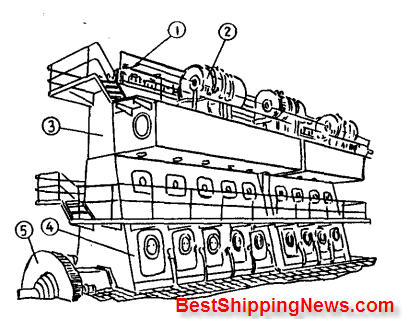
line diagram of engine

Aft%20engine%20type%20cargo%20vessel 1 Cargo ship: general structure, equipment and arrangement ship types

1 . Cylinder head
2. Super charge
3. Frame
4. rind
5. Fly wheel

Comments

Popular posts from this blog

Fresh Water Generator

Converting Seawater to Freshwater on a Ship: Fresh Water Generator Explained Fresh water generator , one of the important machinery on board a ship, is something that cannot be done without. Fresh water produced from fresh water generator is used for drinking, cooking, washing and even running other important machinery which use fresh water as a cooling medium. Fresh water is generally produced on board using the evaporation method. There are two things that are available in plenty on ship to produce fresh water –Seawater and heat. Thus fresh water is produced by evaporating sea water using heat from any of the heat source. The evaporated sea water is then again cooled by the sea water and the cycle repeats. Generally the heat source available is taken from the main engine jacket water, which is used for cooling the main engine components such as cylinder head, liner etc. The temperature available from this jacket water is about 70 deg. centigrade. But at this temperature the evaporati...
Shaftline 1.rudder stock, 2.rudder, 3.propeller bonnet, 4.propeller, 5.stern frame, 6.stern tube sealing, 7.stern tube bearings 8.stern tube, 9.propeller shaft, tail shaft, 10.plummer Mock, pillow block, shaft block, 11.intermediate shaft, 12.thrust shafts 13.flywheel, 14.crankshaft, shaft alley, shaft tunnel,
DIESEL ENGINE

The diesel engine source: Helmut Hütten, "Motoren", Motorbuchverlag Stuttgart, Umschlag Already early Rudolf Diesel (1858 - 1913) was interested in engines. In his youth he was fascinated by the engines of Lenoir and the steam engines that were usual at his time. During his study he learned of his teacher, professor Linde, a famous inventor, that the thermal engine could reach by far a better performance. He referred to the young Frenchman Sadi Carnot (1796 - 1832), who discovered the Carnot' cyclic process, a physical principle that describes the ideal process of the burn in an engine (read more about it in the physics section). Diesel was pursued from now on by the thought to build such an engine. 1890, Diesel had the crucial idea, how the cumbustion process could be improved: The engine takes in just air, which is to be compressed now to a pressure of about 200 bar. At this point, heavy fuel (such as crude oil or petroleum) gets injected by an injector in the air that ...